
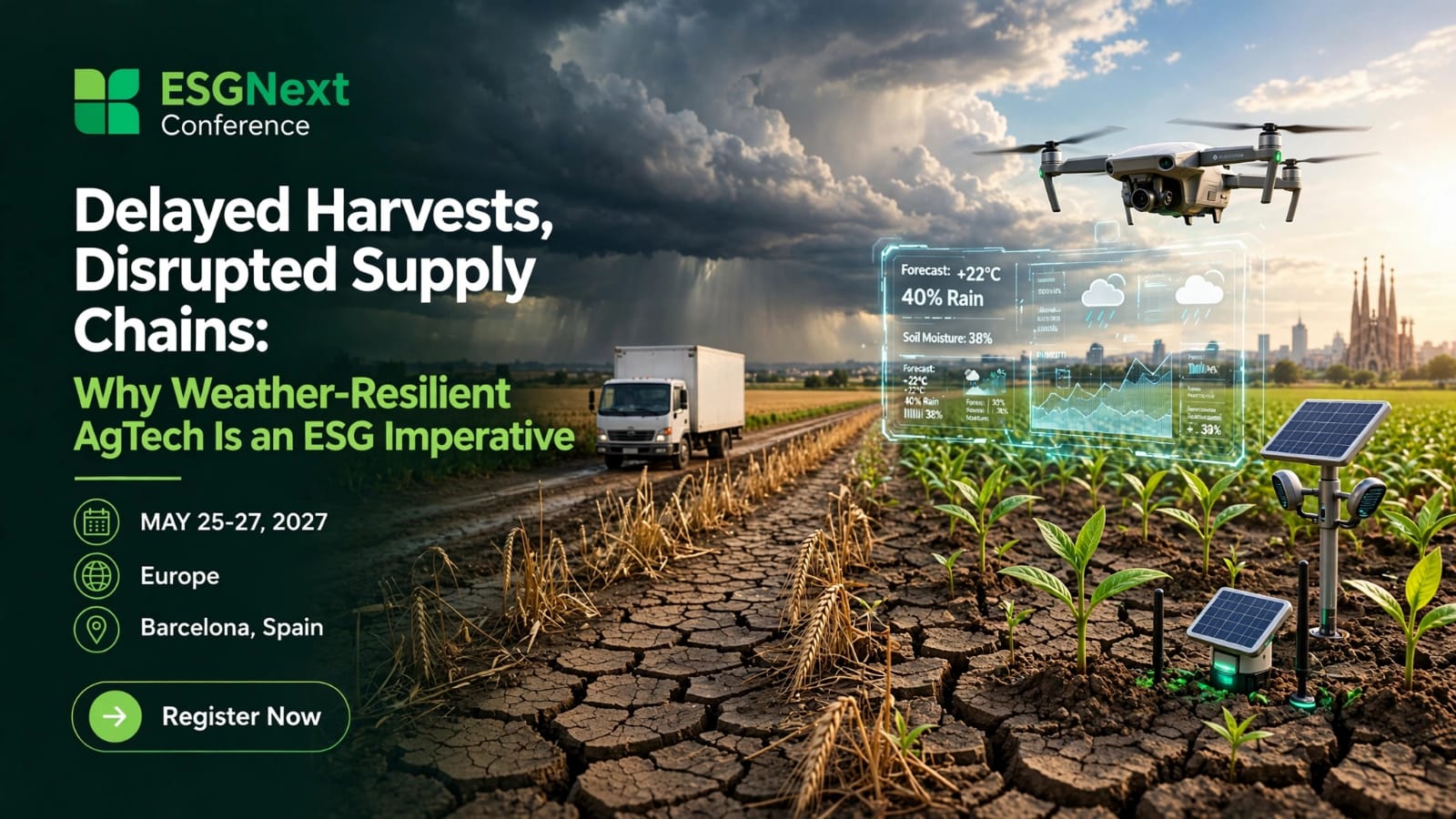
Extreme weather is no longer a distant climate scenario for agriculture—it is a present-day operational risk. Delayed harvests, damaged crops, disrupted logistics, and volatile input costs are increasingly affecting food companies, retailers, investors, and farming communities. As climate pressures intensify, weather-resilient agricultural technology is moving from a productivity tool to a core ESG priority.
Agriculture sits at the intersection of environmental and social risk. Food and agricultural systems account for close to 30% of global greenhouse gas emissions, while climate change simultaneously threatens yields, farmer livelihoods, and food security. In 2022, 2.4 billion people lacked regular access to adequate food, underscoring why climate disruption in farming cannot be treated as an isolated supply-chain issue.
When weather becomes a business risk
Delayed harvests create ripple effects across the value chain. Crops that remain in fields during excessive rain, drought, heat, or early frost can suffer quality losses, spoilage, and reduced market value. Downstream, food processors face inconsistent supply, retailers face pricing pressure, and logistics networks must absorb sudden shifts in timing and volume.
For companies with agricultural exposure, these disruptions affect more than revenue. They influence Scope 3 emissions, water use, biodiversity outcomes, labor conditions, and community resilience. A delayed harvest may force additional storage, transport, refrigeration, or waste management—each with environmental and cost consequences.
This is why weather resilience belongs in ESG strategy. It is not simply about protecting crop yields; it is about protecting the stability of food systems, the livelihoods of farmers, and the credibility of corporate climate commitments.
AgTech as climate adaptation
Weather-resilient AgTech includes a broad set of tools: satellite imagery, AI-based crop monitoring, precision irrigation, soil sensors, drought-tolerant seed varieties, digital weather advisories, and automated farm equipment. Together, these technologies help farmers make faster, more informed decisions as conditions change.
Research by the OECD on climate-smart agriculture and food systems highlights how innovative agricultural technologies and practices can help reduce emissions, improve yields, and strengthen resilience. These approaches are particularly important for smallholder farmers facing increasingly unpredictable weather conditions.
Climate change can significantly affect yields in rain-fed farming systems, while climate-resilient practices—including improved seeds, conservation agriculture, and water-efficient technologies—can help farmers manage climate-related risks. Digital tools also improve farmers’ access to weather forecasts, agronomic recommendations, and market information, strengthening their ability to respond to climate shocks.
The opportunity is particularly significant for smallholder farmers. The FAO highlights affordable, transferable climate-smart technologies such as drought-tolerant seeds, solar-powered irrigation, digital precision farming, post-harvest solutions, and green energy as key levers for improving resilience and productivity.
From resilience to responsible growth
For ESG leaders, weather-resilient AgTech supports multiple goals at once. Environmentally, precision agriculture can reduce water and input waste, while regenerative practices can improve soil health and support carbon sequestration. Socially, it can protect farmer incomes, reduce food loss, and strengthen food availability. From a governance perspective, it gives companies better data to assess climate exposure, manage supplier risk, and report progress credibly.
The business case is also strengthening. In fiscal year 2024, climate finance represented 62% of the World Bank’s lending in the agriculture and food sector, while active projects supported 4.7 million farmers in adopting improved agricultural technologies. This reflects a growing recognition that adaptation investment is essential to long-term food-system stability.
Smarter irrigation in Catalonia
Catalonia’s 2022–2023 drought disrupted irrigation and reduced harvests, particularly affecting fruit growers in the Lleida region.
In response, the MARE project uses satellite data and AI to provide weekly drought and soil-moisture maps, helping farmers decide when and how much to irrigate.
Similarly, IRTA’s IrriPAS network uses soil sensors, plant sensors, smart meters, and decision-support tools to improve water efficiency on Catalan farms.
These initiatives show that weather-resilient AgTech is already helping Mediterranean agriculture adapt to drought—making climate resilience a practical ESG priority, not a future ambition.
The ESG agenda ahead
Weather-resilient AgTech should no longer be viewed as an optional innovation. It is a practical response to a world where climate volatility directly affects harvests, supply chains, and communities. Companies that invest in resilient farming systems will be better positioned to manage risk, meet sustainability commitments, and build trust across their value chains.
The next phase of ESG leadership will depend not only on measuring climate impact, but on enabling adaptation where it matters most: in the fields that feed the world.
Join sustainability, finance, technology, and food-system leaders at the ESG Next Awards & Conference, Barcelona, Spain, from May 25–27, 2027, to explore how climate resilience, innovation, and responsible business can shape the future of ESG.
Register now https://esgnextconference.com